The FreeBSD Diary |
|
(TM) | Providing practical examples since 1998If you buy from Amazon USA, please support us by using this link. |
|
Dual Opteron - better SATA cables for the Raptors
19 August 2006
|
|
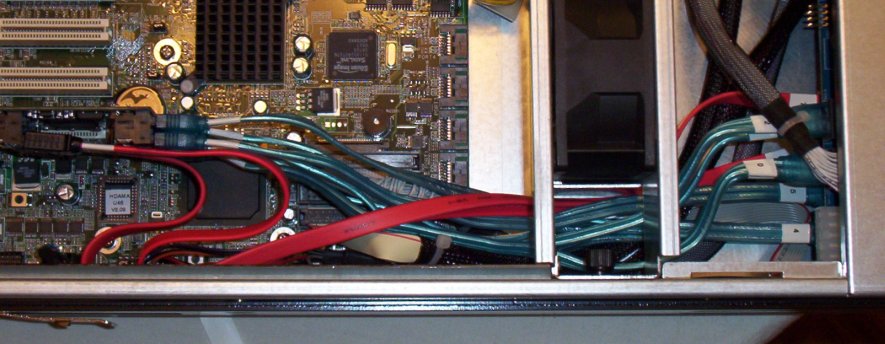
When you need cables, you often need them right now. Fast shipping is great. Overnight is fantastic. It's even better when the vendor calls back and offers you a slightly more expensive cable, for the same price, because the one you asked for is out of stock and will take a few days to order in from the States. This is the service I got from MyCableShop. I found them via Google, and they had the cables I wanted, at a much cheaper price than my local computer shop could source them. I wanted these 12" SATA cables, and with shipping, they'd be about $5 each. Just what I need to solve a messy cabling issue that arose from using 38" cables in a small 2U case. Not only did MyCableShop call me to recommand another cable shortly after I placed my order, but the cables arrived the day after I ordered them. I'm impressed. |
|
The new cable layout
|
|
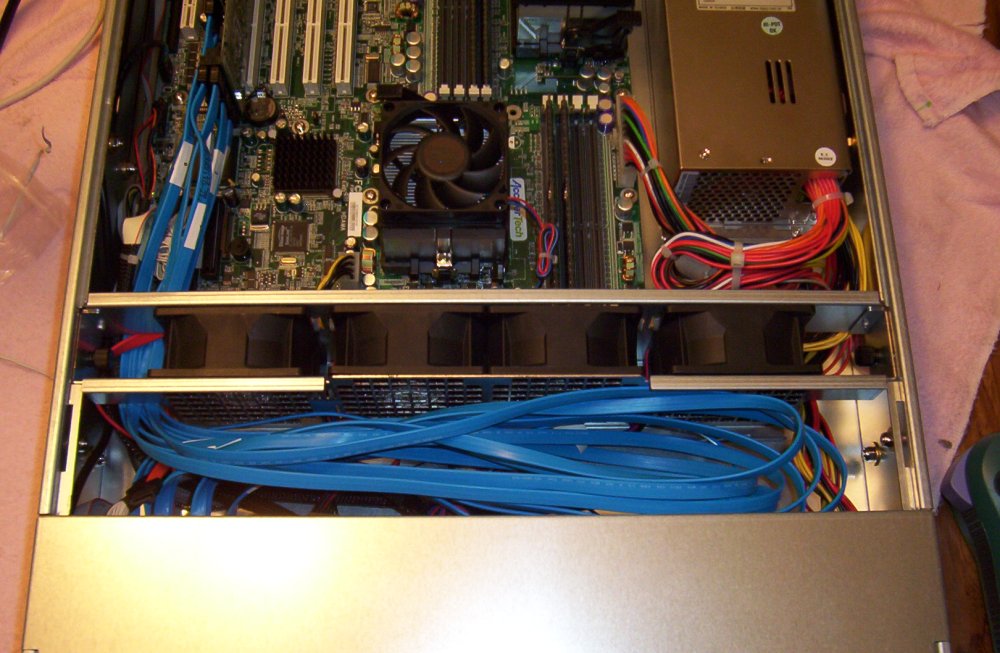
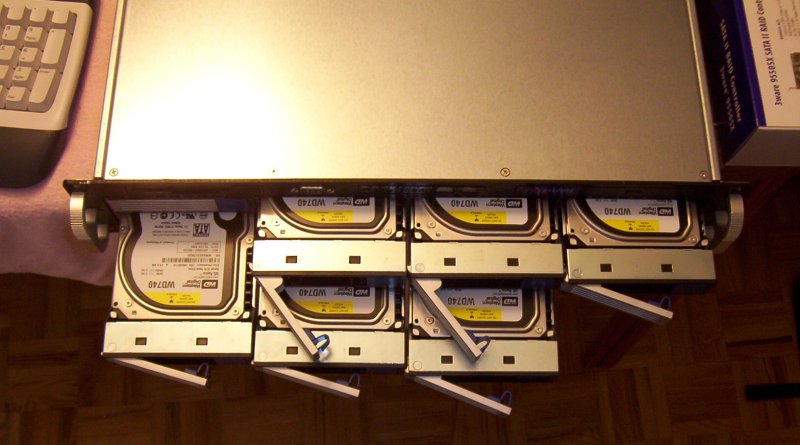
These 18" cables were slightly too long, so I routed the excess to the side of the RAID card. Before I ordered the smaller cables, someone mentioned I could do this for the longer cables, but there was so much excess cable (nearly two feet extra per cable) I thought the right thing to do was get new cables. I'm glad I did. There is one previous photo of the Raptors but it shows only 6 of the 8 drives. The photo below shows all 8 of the Raptors in their cages. 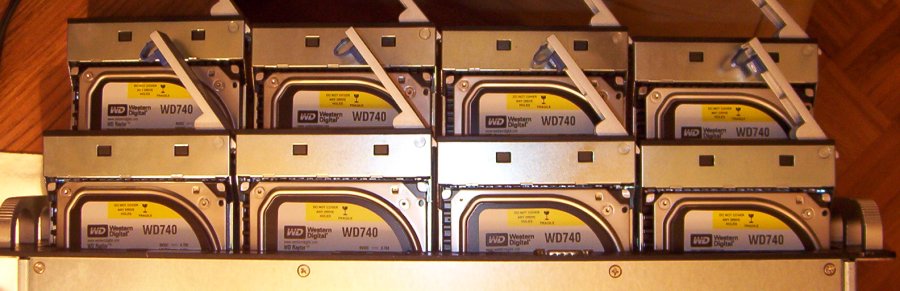
|
|
Are the new cables any slower?
|
|
Cables are cables. They should not matter. But I wanted to make sure. So I did a very simple test. How fast is a disk copy with the old cables? [dan@opti:~] $ time cp -r /usr/ports . real 1m49.440s user 0m0.454s sys 0m10.352s [dan@opti:~] $ time rm -rf ports real 0m16.398s user 0m0.157s sys 0m2.008s [dan@opti:~] $ time cp -r /usr/ports . real 1m47.370s user 0m0.352s sys 0m10.593s [dan@opti:~] $ time rm -rf ports real 0m17.365s user 0m0.137s sys 0m2.084s [dan@opti:~] $ time cp -r /usr/ports . real 1m47.481s user 0m0.439s sys 0m10.541s [dan@opti:~] $ time rm -rf ports real 0m16.547s user 0m0.133s sys 0m2.048s [dan@opti:~] $ time cp -r /usr/ports . real 1m46.543s user 0m0.479s sys 0m10.588s [dan@opti:~] $ time rm -rf ports real 0m17.276s user 0m0.105s sys 0m2.125s [dan@opti:~] $ OK, those are pretty consistent times. Then I change the cables, and nearly die: $ time cp -r /usr/ports . real 2m30.969s user 0m0.406s sys 0m10.693s *COUGH* That's nearly 42% longer, with the only difference being the cables! This can't be right. And it isn't. Let's try again: $ time cp -r /usr/ports . real 1m45.426s user 0m0.438s sys 0m10.645s [dan@opti:~] $ time cp -r /usr/ports . real 1m45.426s user 0m0.438s sys 0m10.645s [dan@opti:~] $ time rm -rf ports real 0m16.939s user 0m0.136s sys 0m2.133s [dan@opti:~] $ time cp -r /usr/ports . real 1m45.467s user 0m0.575s sys 0m10.710s [dan@opti:~] $ time rm -rf ports real 0m19.831s user 0m0.134s sys 0m2.300s [dan@opti:~] $ OK, that's good. It was just a caching issue. Now the times are back to what they were. |
|
Monitoring fan speed/CPU temperature
|
|
I had planned to monitor CPU temperature and fan speed using something such as healthd or mbmon. Unfortunately, neither port is of any use with my m/b. It uses the ADM1026 sensor chip which the current version of mbmon does not support. Unfortunately, it looks quite different from the already supported ADM1025/1027. That's a shame. It seems a pity not to monitor such vital readings. |
|
Next stop!
|
|
Now that I have the right cables, the RAID has been set up, and NetSaint is monitoring the array for me, it's time to start install the software for my services. I plan to do that over the next week. |